
Scott is shown writing in his journal inside Scott’s Hut at Cape Evans on 7 October 1911, months before the outcome of the expedition was known. At that point, the Terra Nova expedition of 1910–13 still carried hope, purpose, and national expectation. It was Scott’s second Antarctic command, following the Discovery expedition a decade earlier, and it was intended to place Britain first at the South Pole.

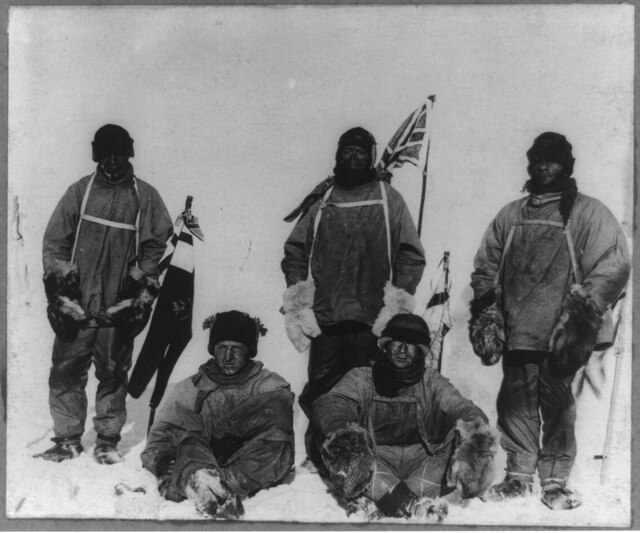
The final polar party consisted of five men. Captain Robert Falcon Scott led the group alongside Dr Edward Adrian Wilson, Lieutenant Henry Robertson Bowers, Captain Lawrence Oates, and Petty Officer Edgar Evans. Together, they pushed south across the ice in the final stage of the journey.
The Pole
They reached the South Pole on 17 January 1912. Waiting for them was a tent left by the Norwegian expedition, and inside it a letter dated 18 December from Roald Amundsen. The race was already lost. Scott recorded the moment with blunt clarity in his diary. “The worst has happened,” he wrote. “All the day dreams must go. Great God! This is an awful place.” There was no attempt to soften the blow or reshape the moment for posterity.

The return journey began on 19 January. It was an 862-mile march back across the Barrier, now undertaken in exhaustion and worsening conditions. Scott noted his fear that the journey would be “dreadfully tiring and monotonous”, words that barely hint at what followed.
Edgar Evans was the first to fall. Injured, weakened, and deteriorating rapidly, he died on 17 February 1912 near the foot of the Beardmore Glacier. The remaining four pressed on, but Captain Lawrence Oates was suffering severe frostbite and was increasingly unable to keep pace. Around 16 March, during a blizzard, Oates left the tent deliberately, telling the others, “I am just going outside and may be some time.” He never returned.

Defeated
Scott, Wilson, and Bowers continued alone, but the weather closed in and their strength failed. They made their final camp just eleven miles short of a supply depot. There they remained, pinned down by storms and lack of fuel. Scott continued writing until the end. He is believed to have died on or about 29 March 1912, possibly a day later. When the tent was found months afterwards, the position of the bodies suggested Scott was the last of the three to die.

A search party discovered the tent on 12 November 1912. Inside were the bodies of Scott, Wilson, and Bowers, along with Scott’s journals and letters. These papers ensured that the final weeks of the expedition were recorded in detail, without hindsight or embellishment.
In the immediate aftermath, Scott and his companions were honoured across Britain as symbols of endurance and sacrifice. Memorials were raised, and the story entered national memory. In later decades, historians would question Scott’s decisions, leadership, and planning. But the journals remain. They show not myth or legend, but five men moving step by step towards exhaustion at the end of the world, recording events as they unfolded, until there was nothing left to write.